Nasruddin’s Burro and Violence, or How to Save Face

by Modaser Shah

Should we believe Nasruddin or his burro?  Do we favor an animal over a fine human being? Before I narrate that story, let’s examine some recent events.

Iran’s president Rouhani said sometime ago that there was no place for violence in Islam. What could he have meant by this?  Does he define these two words, Islam and violence differently from common usage? That where there is violence, Islam does not exist? Or perhaps, where violence exists, Islam doesn’t?

Perhaps it is violence of a certain kind that is claimed not to be compatible with Islam, or being a Muslim. Violence, as usually conceived, has always existed. Three of the four Khulafa-e Rashidun (the Rightly Guided Caliphs) died in a violent manner. Perhaps the perpetrators were not, by definition, adherents of Islam. Does this mean that if someone commits violence of a sort, he/she is to be considered an apostate?

Perhaps, it is violence against legitimate Muslims that is decried as inconsistent with the faith. But who is legitimate? Any person of any faith or no faith can claim legitimacy of his/her belief.

So, Nasruddin or his burro?

Perhaps it is unjustified violence that is being disowned, not the violence justified by divine decree or by fatwa, such as the Iranian fatwa issued against Salman Rushdie, which has, as far as I can tell, not been rescinded. Is the action ordained by this fatwa non-violent?

Perhaps Rouhani is simply saying that the Islam he follows has no place for violence. That his government would renounce violence, if he had the power. If so, he runs the risk of  a fatwa against him by the powers that be.

As far as one can tell, Da’ish has never claimed that their version of the religion disfavors violence. If they did, the gulf between their words and their actions would be too glaring. However, even in the case of Mr Rouhani, there remains a gulf between words and actions. The words are doing violence to the facts. Is he willing to see the facts, reality?

Now the story. A friend went to Nasruddin’s house  early one  morning and asked if he could borrow his burro. The Mullah apologized that he could not grant this favor because someone else had already taken the animal. To demonstrate his “sincerity,” he was effusive in his apology. Meanwhile, the donkey, not having been consulted in the matter, broke its silence and started to bray loudly. The friend was shocked, having found out, in the braying of the burro, that the Mullah had lied.  The Mullah, never one to acknowledge a faux pas, started to accuse his friend of having such little regard for their friendship that he (Mullah’s friend) would take the “word” of a burro over the Mullah’s, cursing the times that had degraded ties of friendship to such an extent! He was offended. The point for him was not that he lied, but that his word has been given less value than that of his animal.

A point missed, a face saved. A dialogue broken off. The casualty: truth.

And for us to ponder: Actions or words? His burro or Nasruddin? Facts or face?

Posted in Modaser Shah, Uncategorized | Tagged , , , , , | Leave a comment

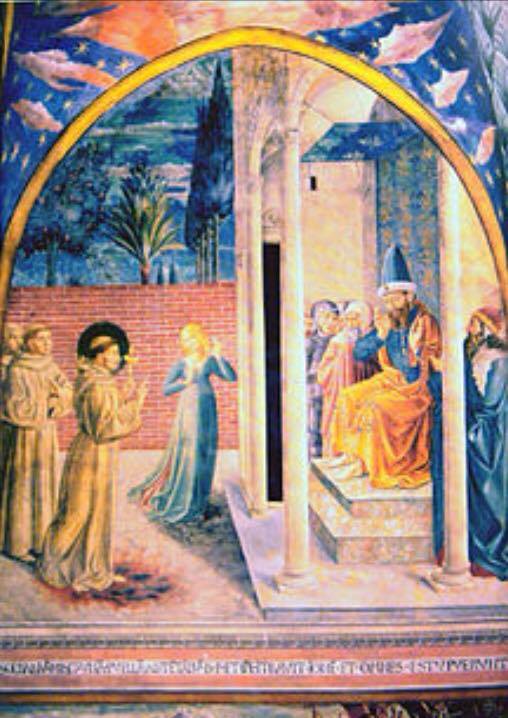
St. Francis of Assisi and Sultan al-Kamil: A Bold Christian-Muslim Encounter

St Francis

by Navid Zaidi

St. Francis of Assisi (1181-1226) was the privileged son of a wealthy Italian merchant but gave up his possessions and adopted a life of peace, poverty, compassion and nonviolence.

In a moment of conversion, while praying on his knees before a crucifix in 1205, Jesus spoke to him from the image on the cross: “Francis! go, repair my house which is falling completely to ruin.” Francis saw this as a request to transform the entire Christian church. He was reborn as a peacemaker and was convinced that God wanted him to bring the world a message of peace.

He adopted the signature greeting “May the Lord give you peace” and constantly opposed warfare, arrogance and the violent culture of his day.

In 1215, Pope Innocent called for the Fifth Crusade and in the spring of 1217 the armies from all across Europe slowly gathered and headed for Egypt. The Muslim and Christian armies camped across the Nile. As the war raged on over the next two years, thousands were killed on both sides.

Sultan Malik al-Kamil, ruler of Egypt and a nephew of the great Kurd warrior Saladin, repeatedly tried to negotiate peace by returning Jerusalem to the Crusaders but the pope rejected the offer each time.

While men slaughtered one another in God’s name beside the waters of the Nile, Francis gathered his community of brothers in Italy. Francis had always dreamed of preaching the Christian faith peacefully to the Muslims and yearned for an audience with a Muslim leader. Now his moment had arrived and he was going to forbid war and be a peacemaker.

In June 1219, Francis took a few brothers with him and sailed on a perilous journey across the Mediterranean to the war zone.

Upon reaching the banks of the Nile, Francis was deeply grieved to see the horrific sight of casualties of war on both sides. He retreated into deep prayers and contemplation and wondered what he could do. He began to preach vigorously against the war, forbidding it and threatening disaster but was faced with foulmouthed jeers and taunts; to the Christian soldiers the barefoot little holy man was a heretic. Despite this, Francis continued his opposition to war but all of his efforts were to no avail.

Finally, Francis decided that he would act and he and brother Illuminato would venture out to meet the Muslims in their own camp. Francis understood the risks; death or imprisonment were the likely outcomes of his plan to cross the enemy lines during wartime. But Francis had a bold idea to prevent bloodbath. If the Crusade leaders would not seek peace, he would.

As Francis and Illuminato crossed the enemy lines, the Muslim sentries saw them and thought they were messengers or had come to convert to Islam. Indeed, soldiers on both sides of the Crusade had converted.

Francis, unable to speak the soldiers’ language, cried, “Sultan ! Sultan !” The soldiers seized them and led them to the sultan’s tent.

The future saint and the sultan were roughly the same age, al-Kamil was 39, Francis 38.

Francis stood before al-Kamil. The sultan looked over the odd duo, barefoot monks dressed in coarse, patched down tunics. The sultan thought that the Franks had sent them to his tent with a response to his latest peace proposal. The sultan, made weary by war, desperately wanted a deal that would end the Christians’ siege of the port city of Damietta where his people were dying of disease and starvation.

“May the Lord give you peace.” Francis surprised the sultan with his standard greeting. It perplexed the sultan. He noticed the similarity between Francis’ greeting and the familiar Muslim greeting of peace, Assalam o alaikum or “peace be upon you.”

The Quran urges to be courteous to those who use a greeting of peace: Say not to those who greet you with peace, “You are not a believer.” (The Quran: Women 4:94) and When you are greeted with a greeting, greet in return with what is better than it, or (at least) return it equally. (The Quran: Women 4:86)

Uncertain about his visitors’  intentions, the sultan asked if they had come as representatives of the pope’s army.

“We are ambassadors of the Lord Jesus Christ”, Francis responded, asserting that he was God’s ambassador, not the pope’s.

This daring little man and his companion intrigued Sultan al-Kamil – they even resembled the similarly dressed Sufi men the sultan revered for their mystical insight into Islam. (Sufism is not a sect of Islam, but a peculiar influence within Islam.)

“If you wish to believe us, we will hand over your soul to God,” Francis continued.

Whatever Francis said, the sultan became very attentive to and listened closely. It was an amazing scene of a monk preaching the Christian faith to a Muslim monarch in the middle of a war.

The sultan’s religious advisers were rushed into his tent. Once they found out that al-Kamil was going to let Francis preach, they warned him that this would violate Islamic law.

Influenced by Sufism, al-Kamil believed he was acting within Islamic law in listening to Francis and Illuminato. The Quran does not prescribe or even refer to the death penalty for blasphemy. Indeed, the Quran suggests tolerance in the situation faced by the sultan: And you shall certainly hear much that will insult you from those who received the Scripture before you and from the polytheists. But if you persevere patiently and guard against evil, this will be the best course with which to determine your affairs. (The Quran: The House of Imran 3:186)

Al-Kamil had a prominent Sufi as his religious adviser and he saw Francis in the light of Sufism and the Muslim tradition calling for respect for Christian monks.

The Muslims’ relations with the Christians are determined for them by the Quran, which says: And you will find nearer to the friendship of the believers those men who call themselves Christians. This is because among them are learned men and monks, and because they are not arrogant. (The Quran: The Repast 5:82)

In their rough, patched up tunics Francis and Illuminato looked like Sufis, since the very name of Sufis came from the Arabic word for wool, the scratchy material used to make their robes. Like Francis, they also wore a cord rather than a belt.

Francis was a dynamic preacher. He preached from the heart and the sultan and his court listened to Francis attentively. The discussions went on for several days and had multiple participants. It was a peaceful exchange of ideas about the two competing religions. Francis and Illuminato were treated as honored guests in the Muslim camp.

Francis was deeply impressed by the Muslim religious practices, especially the call to prayer.

The sultan offered Francis many gifts but Francis turned them down. Francis did, however, agreed to accept a token of their meeting; an ivory horn used to make the Muslim call for prayer, which is now displayed in a room of relics at the Basilica of St. Francis in Assisi. Francis used it to call people to hear him preach on his return to Italy.

Although Francis was disappointed not to have converted the sultan, he had shown Sultan al-Kamil what it meant to be a true Christian. He and al-Kamil had found a way of talking peacefully during a gruesome war. Sultan then sent Francis and Illuminato back to the Christian camp under his protection.

The Fifth Crusade ended in 1221 in a decisive victory for al-Kamil which resulted in a great number of losses on both sides and eventually in the surrender of the pope’s army. Al-Kamil agreed to an eight-year peace agreement with Europe.

Francis returned to Italy soon after his encounter with the sultan but held the sultan deep within his heart. He grew ill but his yearning for peace intensified. He constantly preached to abolish war and renew peace agreements.

In the summer of 1224, the call for another crusade went out across the land. Francis was struck with grief and went on a solitary retreat to observe a forty-day period of fasting and prayer. It was during this solitude that Francis had a miracle in which he received the wounds of the crucified Jesus on the basis of which he was later canonized as a saint.

When Francis emerged from this vision, he wrote a prayer on a parchment that resembled the Muslim meditation on the 99 Most Beautiful Names of God. Francis was apparently inspired by the prayers he learned about while in the Middle East.

On the same parchment, Francis drew the head of a man at the bottom. The face Francis drew represented none other than Sultan al-Kamil. It was a heartfelt prayer for God to protect Sultan al-Kamil and bring peace.

Francis wept through his last years. He stayed within a dim cell of a church and died on October 3, 1226. He was canonized as St. Francis of Assisi in 1228.

Sultan al-Kamil prospered in his remaining years and died in March 1238 having ruled Egypt as viceroy and sultan for some 40 years.

The encounter between Francis and the sultan provided the foundation for the World Day of Prayer for Peace in Assisi in 1986.

St. Francis’s encounter with Sultan al-Kamil in 1219 can be an antidote, a reminder that responding to violence through violence cannot succeed, that goodness and respect can really change hearts.

The dynamic of stirring a populace to war has not changed over time; it still begins with demonizing the enemy. Francis saw through that.

The road to peace is for all of us, on individual basis, at personal level. Francis took matters into his own hands by bravely seeking out a personal relationship with the sultan. And al-Kamil went deeper into his own religious tradition to retrieve the theme of respect for holy Christians, even though he was under attack by the pope’s army.

Hostility is more likely when one people is distanced from another and demonized. Peace gets a chance when the divide between people is bridged through personal relationships.

This article is based on the following book:

The Saint and the Sultan: The Crusades, Islam, and Francis of Assisi’s Mission of Peace

by Paul Moses, Professor of Journalism at Brooklyn College, CUNY, New York.

Posted in Navid Zaidi | Tagged , , , , | 14 Comments

Dasht-e-Hasti (Sands of Existence)

by Ali Hammad

دشتِ ہستی میں نہاں خوشبو بھرا گلزار عشق
ہے یہ دنیا اور یہ عالم، ہر سکوت اور کار عشق

ہر سماعت اور ہے سامع، منظر و ناظر بھی خود
نکتہ بین و نکتہ چیں ہے، معجزہ ہے یار عشق

پارساؤں کا سمندر کیوں یہ تیرے میرے بیچ
اک نڈر غوطہ لئے کرتا مجھے تیّار عشق

سوختہ ہو جب وفا، ملتی جنوں کو ہے جِلا
نار پروانوں کی اور دیوانگی کا وار عشق

غم نہ کر حاؔمی ذرا تو، تیرا پیالہ بھر چلا
مے دھری ہی رہ گئی ہے، کر چلا سر شار عشق

TRANSLITERATION

dasht-e-hastī meñ nihañ ḳhushbū bharā gulzār ishq
hai yeh duniyā aur ye ālam, har sakūt aur kār ishq

har samā.at aur hai sāme, manzar-o-nazir bhi ḳhud
nuktabīn-o-nuktachīñ hai, mo.ajza hai yār ishq

pārsā.oñ ka samandar kyuuñ ye tere mere bīch
ik niḍar ġhotā liye kartā mujhe tayyār ishq

sōḳhta ho jab vafā, miltī janūñ ko hai jilā
nār parvānoñ kī aur dīvāngī kā vār ishq

ġham na kar “hāmī” zarā tū, terā piyālā bhar chalā
mai dharī hī rah ga.ī hai, kar chalā sar shār ishq


TRANSLATION

Sunk beneath the sands of existence lies a fragrant garden: the Essence
This world and this form, each pause and each tick is it: the Essence

Itself is it the song and the listener, the scene and the beholder
The knower and the critic; a miracle, no less: this Essence

Stretches between you and me a sea of the righteous
And who readies me for an intrepid plunge? The Essence

Set afire attachments to fuel a mad love
Flame for the moth, a coup of unreason it is: the Essence

Cast away your angst, ‘Hami,’ as your chalice (of being) fills
Care not for any wine, as you drown in this: the Essence


Posted in Ali Hammad, Classic Poetry, Original Music, Original Poetry | Tagged , , , , , , , , , , | 3 Comments

Solvitur Ambulando….. “It is solved by walking (away)”

Diogenes_looking_for_a_man_-_attributed_to_JHW_Tischbein
by Navid Zaidi
Diogenes of Sinope (412-323 BC), also known as Diogenes the Cynic, was a Greek philosopher probably best known for his fruitless search for an honest man. He used to roam about in Athens in full daylight with a lamp in his hand and when asked what he was doing, used to reply, ‘I’m just looking for an honest man.’ He looked for a human being but reputedly only found rascals and scoundrels.
However, equally remarkable was his ability to act out the message he was trying to convey. Lore states that in a debate about the nature of motion, Diogenes, in response to an adversary’s argument that motion does not exist, stands up and walks away, prompting the Latin phrase ‘ solvitur ambulando.’ Although the literal translation of ‘solvitur ambulando’ is ‘ it is solved by walking’, the common interpretation of the phrase is that a problem is only solved by practical experiment. Virtue is better revealed in action than in theory.
Diogenes was born at Sinope (modern-day Sinop, Turkey), was exiled and moved to Athens where he challenged and criticized the established customs and social institutions. He called himself a ‘citizen of the world’ (cosmopolites) and is credited with the first known use of the word ‘cosmopolitan.’ This was at a time when a man’s identity was intimately tied to his citizenship in a particular city-state. Diogenes was an exile and an outcast, a man with no social identity, but he made a mark on his contemporaries.
Diogenes used to challenge Plato and his abstract philosophy. He regularly disturbed Plato’s lectures. When Plato gave Socrates’s definition of man as ‘featherless biped’ and was much praised for this definition, Diogenes plucked a chicken and brought it to Plato’s Academy saying, ‘Behold! I’ve brought you a man.’
Diogenes lived in a large clay jar, in poverty, begged for a living, slept and ate wherever he chose against all the cultural norms of Athens. He publicly mocked Alexander the Great. In a famous encounter, while Diogenes was relaxing in the sunlight one morning, Alexander, thrilled to meet the famous philosopher, asked if there was any favor he might do for him. Diogenes replied, ‘Yes, stand out of my sunlight.’
Diogenes is considered one of the founders of Cynicism. For the cynics, the purpose of life was to live in virtue, in agreement with nature. As reasoning creatures, people could gain happiness by living in a way which was natural, rejecting all conventional desires for wealth, power, sex and fame. Instead, they were to lead a simple life free from all possessions. Diogenes destroyed the single wooden bowl he possessed on seeing a peasant boy drink from the hollow of his hands. He exclaimed, ‘Fool that I am, to have been carrying superfluous baggage all this time.’
Diogenes was captured by pirates and sold as a slave in the Greek city of Corinth where he grew old and died at an age of 89. The Corinthians erected to his memory a pillar on which rested a dog as there were many stories of Diogenes referring to his ‘dog-like’ behavior and his praise of a dog’s virtues.
Diogenes tried to show that wisdom and happiness belong to the person who is independent of society, civilization, family, politics, property and reputation. Like Diogenes, perhaps one can solve the most complex problems of life by walking away, stop being offended, letting go of the need to win, letting go of the need to be right, letting go of the need to be superior, letting go of achievements and reputation.
And on this path one can hope to have more success than Diogenes’s search for an honest man. Perhaps someone has a lamp we can borrow…….
(Painting: Diogenes looking for a man – attributed to JHW Tischbein, public domain, taken from Wikimedia Commons)
Posted in Navid Zaidi | Tagged , , , , , | 1 Comment

Ishq Kia Hai (Define Love): A Ghazal

by Ali Hammad ‘Hami’

عشق کیا ہے، کیا وفا اور کیا ہے آس
بھوک ملنےکی یہ جلنے کی ہے پیاس

بندگی ہے نام جس کا میں ہی ہوں
قید میں ہیں آپ کی میرے حواس

ہوں جدا شعلہ الاؤ سے میں ایک
اور تنہائی نہ آئے مجھ کو راس

میں معلّم ہوں وفا کا بس کہ یوں
ہر پتنگا ہو کے جاتا میرے پاس

اک پریشاں سا تفکّر زندگی
ہے ثباتی گرکوئی تیرا قیاس

TRANSLITERATION

ishq kia hai, kia vafā, aur kia hai aas
bhuuk milne kī, ye jalne kī hai pyās

bandagī hai nām jis kā, maiñ hī huuñ
qaid meñ haiñ aap kī mere havās

huuñ judā sho.alā alāv se maiñ ek
aur tanhāī na aa.ē mujh ko rās

maiñ moallim huuñ vafā ka bas ki yuuñ
har patiñgā ho ke jātā mere pās

ik pareshāñ sā tafakkur zindagī
hai sabātī gar koī, tera qayās

(Ali Hammad ‘Hami’)

TRANSLATION

What constitutes love, or attachment, or hope?
A longing to unite, and the desire to burn in that longing

An epitome of relinquishment, I am
As you have taken charge of my senses

I’m a spark ejected from the conflagration
And I can’t come to terms with this aloneness

I am the purveyor of attachment, behold!
Each (flame-loving) moth first comes to me (for initiation)

No more than a stray thought, this life
No constancy hither, other than your thought

(Ali Hammad ‘Hami’)


MUSICAL RENDITION

(omits the third verse of the above ghazal)

Composed and performed by: Abbas Ali Khan

Written by: Ali Hammad ‘Hami’

Produced by: Aziz Anjum


Posted in Ali Hammad, Original Music, Original Poetry | Tagged , , , , | Leave a comment

Goethe, Nasruddin…and Da’ish

by Modaser Shah

“Mehr Licht (More light),” said Goethe.

While, in the fable of the Lost Keys, Mullah Nasruddin points to the dark to look for lost keys, Goethe, captivated by the spirit of enlightenment, calls for more light. Get rid of all darkness, he seems to say, let’s have light only.

But, I think, the Mullah seems to be going deeper, saying that there is darkness in light, as there is light in darkness, truth in falsehood and falsehood in truth. There is no pureness anywhere to be found. There is an old saying based on this dialectic: Respect those who search for the truth; beware of those who have found it.

And what is ISIS but one example of escape from the complex reality that the world has become for modern Muslimhood. It would like to see it the way it used to be: shorn of any differences, conflicts, dialectical contradictions, light and darkness. Hence is the need for destruction: wiping out Muslims with different interpretation of the religion, people of other cultures and languages, extirpation of pre-Islamic relics (lest those relics of their own forefathers lead the current and future generations away from purity). In this sense they are in perverse agreement with Goethe, not Nasruddin: they feel they possess the light that must banish all darkness, although their movement is in the opposite direction from what the great poet would have wished.

Whereas DA’iSH (ISIS) believes it has found THE TRUTH, the one true version of the religion, the light with which all darkness must be banished, the Mullah seems to say the “keys” are always going with wherever the darkness goes; this is how the world and human beings are, in esse.

In another fable, the Mulla was grateful when he lost his donkey, that he was not riding the beast when it lost its way. He was happy to keep his confused, contradictory, conflicted humanity in not being on the donkey into a world of robotic simplicity, where someone does your thinking for you and tells you what to do and where to go.

In yet another story, the Mullah was asked where the center of the earth was. His vanity didn’t allow him to say he did not know. Instead he said it was under his donkey’s legs. To forestall further queries and doubts, he challenged his interlocutors to go measure it, if they doubted his answer!

Perhaps, he did know.

Posted in Modaser Shah, Uncategorized | Tagged , , , | Leave a comment

ISIS and the dead

by Modaser Shah

Da’ISH, or ISIS, has claimed responsibility for a recent (4/19/2015)  suicide bombing in Jalalabad; the Taliban have condemned it. The latter are looking more & more like moderates in light of what the former is only too willing to take credit for. ISIS seems to require more  dead people, and it refuses advice, perhaps ascribing to the aphorism:  Optimi conciliari mortui (The best counsellors are the dead ones).
A Zen monk and a Guru were travelling together along a riverbank and decided to visit an adjacent island. The Guru sugested they walk. “Why not take the ferry?” the monk said. The Guru said because he had spent twenty years learning to walk on water, to which the monk responded: Why take twenty years learning to walk on water,when you can take a ferry for a paisa (penny)?

Perhaps there is a less expensive way (in terms of lives!) to achieve what they are striving for, their desire (unless it is death that they desire).  Are years of mayhem necessary?

A Zen saying goes, “Today’s enlightenment becomes tomorrow’s delusion.” An ideology may be perceived as an enlightenment at a particular time. But perhaps not for long, at least not all of it. Contradictions, paradoxes, absurdities, even falsities being part & parcel of a human (all too human!) whole, splits & conflicts arise and deconstruction &  new synthesis follow. The wheel keeps  turning.

The question is: Will the split represented by ISIS lead to a new synthesis? If there is a potential there, then there are opportunities for development, arising from the existence of what otherwise strikes most people as a malignant growth. How can anything good come out of a cancer?

Most Muslims tend to deny that members of this organization are Muslims, given that ISIS indulges in wholesale Takfir, which is decried as an extremist practice.

It is worth considering that they and other such groups represent certain elements in our history, psychology, ideologies and practices, that we don’t want to face up to, because they contradict our ideal images of our ancestors & ourselves; our need to see them as more than just human. ISIS,then, is doing the service of bringing to our attention things we would not rather think about, but deny or repress. They are the “return of the repressed,” in psychoanalytic terms, the way the haunting spirits of the dead are.

The denied or repressed elements can go back for generations; ISIS may represent the transmitted traumas of our collective & individual pasts. It is well known in psychiatry that unmourned & unintegrated traumas & losses tend to repeat themselves in one way or another, looking for a way out, looking for recognition and acceptance. The past haunting the present, blocking the future! Isn’t that what ISIS is, a  past disfigured by the present or vice versa?

There are innumerable losses, traumas stemming from early history, but one that was certainly uniquely catastrophic in the extreme, was the Prophet’s death, for which the community was not prepared, as can be inferred from Abu Bakr’s & Omar’s diametrically opposite reactions. The latter  showed a more emotional response, threatening to kill anyone who spoke the truth about what had happened, i.e., the reality of loss. The former was more cool & rational; he prevailed, and yet, for that reason, the community could not mourn & process the traumatic loss & confusion & so had to pass this task on to future generations, to us, and more than likely we are going to pass these on.

As you may recall, Nasruddin (the wise fool of the Sufi lore) was looking for his lost keys where there was light, rather than where he had lost them, in the dark. The past is “known”, or taken to be known; the present & future are not. The former is the light, the latter the dark. Hence,the part of us that is “ISIS” is looking for “the keys” in the certainties of the reported, unrepressed past, not in the uncertain darkness of the shunned/dead  past, or the present & the future.

The formula seems to be: follow the acceptable past and the future is guaranteed.

What was Nasruddin trying to tell us?

He was asked once how old he was. He said 40 years old. Asked the same question several years later, he gave the same answer. When questioned about his truthfulness, he said “A truthful man does not turn away from his word.” What a mullah! Stick to the (told) truth & time, aging stop. This strategy would stop, indeed reverse, the passage of time, undo/deny the reality of loss, of abandonment, humiliations (of growing old, whether for an individual like the Mullah, or a civilization).


Posted in Modaser Shah, Uncategorized | Tagged , , , | 2 Comments

The Law of Human Nature

by Navid Zaidi

In order to grasp the meaning of existence I must be in a position to study some privileged case of existence which is absolutely unquestionable and gives me assurance of a direct vision of Reality.

Fortunately, I am in possession of such a special case: Myself.

Now, my perception of the universe is superficial and external; but my perception of my own self is internal, intimate and profound. I do not merely observe humans, I am human. It follows, therefore, that my own conscious experience of myself is that privileged case of existence in which I am in absolute contact with Reality, and an analysis of this privileged case is likely to throw a flood of light on the ultimate meaning of existence.

What do I find when I fix my gaze on my own conscious experience?

“Two things fill me with constantly increasing admiration and awe, the longer and more earnestly I reflect on them: the starry heavens without and the Moral Law within.”     –  Immanuel Kant

I am always haunted by the idea of a kind of behavior I ought to practice, I may call it fair play, or decency or morality. It tells me what I ought to do. In other words, when I deal with Nature, something else comes in above and beyond the actual facts. I have the facts (how I behave) but I also have something else (how I ought to behave). In the rest of the universe there need not be anything but the facts. Electrons and molecules behave in a certain way and that may be the whole story. But I behave in a certain way and that is not the whole story.

Consequently, as explained by C.S Lewis (Oxford and Cambridge Scholar), the Law of Right and Wrong is a real thing, not made up by myself. It is something above and beyond the ordinary facts of my behavior and yet real- a real law that none of us made but I find it pressing on me. I am always forced to follow the Moral Law and believe in a real Right and Wrong, whether I like it or not.

So, the creature called human has this Moral Law. Everyone knows it by nature and does not need to be taught it.

Nature is subject to various laws, gravitation, motion, laws of physics and chemistry but there is a great difference. A stone cannot choose whether it obeyed the law of gravitation or not, but a human can choose either to obey the Moral Law or to disobey it.

We cannot bear to face the fact that we are breaking the Moral Law. Humans all over the world have this idea that they ought to behave in a certain way, and cannot really get rid of it. In this regard, we compare the moral teachings of ancient Egyptians, Hindus, Greeks, Chinese and Romans, they are all strikingly similar to one another and to our own nowadays.

The Moral Law tells me that there is a Something behind the universe which appears in me as a law urging me to do right and making me responsible and uncomfortable when I do wrong.

‘Something unknown is doing we don’t know what. That is what our theory amounts to.”   (Sir Arthur Eddington, expressing the quantum theory).

And consider these words of the Nobel Prize-winning physicist Max Planck (the father of quantum theory) as he accepted his award for his study of the atom:

“As a man who has devoted his whole life to the most clear-headed science, to the study of matter, I can tell you as a result of my research about atoms this much: There is no matter as such! All matter originates and exists only by virtue of a force which brings the particles of an atom to vibration and holds this most minute solar system of the atom together…..We must assume behind this force the existence of a conscious and intelligent mind. This mind is the matrix of all matter.”

I have to assume it is more like a Mind than anything else behind the Moral Law. That is to say that this Universal Mind is conscious, and has purposes, and prefers one thing over another. This conscious Mind has placed the Moral Law into my mind and is intensely interested in right conduct- fair play, unselfishness, courage, good faith, honesty and truthfulness.

REFERENCES:

C. S. Lewis:    Mere Christianity

Allama Iqbal:   The Reconstruction of Religious Thought in Islam

Francis Collins:    The Language of God

Paul Davies:    The Mind of God

Wayne Dyer:    The Power of Intention

Posted in Uncategorized | Leave a comment

The Power of Feelings

by Navid Zaidi

The mind is everything. What you think you become ——–Buddha

As you think so shall you be ——- Jesus

Once a tall young man came to Lahore from the town of Merv in Afghanistan. He went to see the venerable saint Ali Hujwiri (990-1077), the patron saint of Lahore, Pakistan, popularly known as Data Ganj Bakhsh (the Master who bestows treasures) to seek guidance. He told the saint that he was hemmed in by his enemies and didn’t know what to do. He said he felt like glass in the midst of stones.

Saint Hujwiri replied:

” You have not learned anything about life. Be without fear of others !  You are a sleeping force: awake!  When the stone thinks of itself as glass, it becomes glass and gets on the way of breaking. When the traveler considers himself weak, he delivers his soul to the robbers. How long will you regard yourself as water and clay? Why are you complaining about enemies; your enemy is your friend. Your enemy crowns you with glory. You should consider a powerful enemy to be a blessing from God. To the seed of Man the enemy is as a rain-cloud; he awakens its potentialities. If your spirit is strong, the stones in your way are like water. What is the use of eating and sleeping like a beast? What is the use of being unless you have strength in yourself. Know the states of Self and be a man of action, like Joseph, advance from captivity to empire ! ”

What does the Sufi saint really mean?

Our feelings have a lot to do with who we are and what we do. They play a major role in our circumstances and the people that show up in our lives. What we focus on, our beliefs, our fears, our worries and doubts become our reality because they are present in our minds.

We make our world with our thoughts. If we think we are weak we become weak, and if we think we are strong we become strong. Everything is energy and with our thoughts we send our vibrations into the universe, we get back what we send out there. It is a law, just like the law of gravitation, we have the law of attraction.

If we think we are strong we will send a strong signal to the universal field and we will start attracting all the strength in our lives, all the wonderful situations and people that will make us stronger. Like attracts like.

Whether you think you can or can’t, you’re right ——- Henry Ford                                   

We become what we think about all day long   ——-   Ralph Waldo Emerson

If we want to change our lives we have to change the way we think. Shift our attention from weakness and illness towards strength, health and happiness. Keep an open mind. Be patient. Have faith.

Posted in Modaser Shah, Original Essays | Tagged , , , , , | 1 Comment

Learning After You Know…

by Modaser Shah

“It’s what you learn after you know it all that counts.”  (Earl Weaver, Zen Calendar)

Behind this know-it-all, self-sufficient posture is uncertainty and doubt, those truly human qualities.I f you don’t recognize & own these, the need to learn from someone other than yourself, it is  hard  be open to knowing.

One needs to learn how to learn (Idries Shah) and learn how to unlearn and to let go or drop things. Nasruddin (the Sufi sage who was always in guise of a fool) had to drop his keys before he could begin to learn and to teach by showing. He did this by looking for the keys under a lamppost, not in the dark where he had actually lost them.

The Tao view of learning is as follows: “In the pursuit of learning, every day something is acquired. In the pursuit of Tao, every day something is dropped.”

These are two different states of consciousness.That of learning in the usual sense and that of Tao. They are different, but not separate. They imply and contain each other. To pass from one to the other, something has to (be let) go, not something trivial but something deep within:

“Wherever I may be I meet him, he is no other than myself. Yet I am not he.”  (Dosan, Zen Calendar)

Is this an attack on logic, on I-ness and He-ness, on identity? Does it weaken or threaten you? Or strengthen you? Or both.? It is apparently not a zero sum game. The laws of thermodynamics don’t apply. Or if they do, they don’t fully.

“Knowing ignorance is strength; ignoring knowledge is sickness.” (LaoTsu)

So what happens to the self-sufficient persona, as it faces the REAL or the Other? Let us listen:

“I should be content to look at a mountain for what it is and not as a comment on my life.”   (David Ignaow)

The mountain as a mountain, a thing in itself; not diminishing or exalting one’s existence. Seeing things as they are, no more, no less. How simple and how hard.

What about the painful struggles and suffering, that are the fate of those who dare to drop their self-sufficiency, to be alive and  jump into the river of fire,  as Ghalib, the Sufi Indian poet,  says. The struggle of forming and unforming, life and death. The Heart Sutra (some have called it The Heart Attack Sutra) waxes eloquent:

“All form is emptiness, all emptiness is form…

No old age and death and no end to old age and death.

No suffering and no end to suffering.”

This is Nirvana, enlightenment. Not self-sufficiency by any stretch.

Allama Iqbal says: if you are thirsty for a look, close your eyes, to make sure that no one looks. A wise artist said:” In order to see, I have to close my eyes.”  So there is looking without seeing; seeing without looking.

One has to gaze at reality,but this is not without danger to identity. It may be you. And yet not you. You and not-you, this can be shocking and intoxicating at the same time. Lost & found. Like Nasruddin’s keys, you can’t be found until you are lost, a believer until an unbeliever, sane until insane. Clean follows unclean.

A quote from After the Ecstasy, the Laundry (The title of a book on Zen): Having sense emerges out of senselessness

The translation of a verse by Maulana Amir Meenai: “The pious naively invite us to the mosque; If we  had sense, why would we be in the tavern?”  So, in closing the eyes and losing sense, giving up  your identity, you may become who you were meant to be. You may win some, you may lose some. Head to the tavern and lose your senses, piety blossoms in the middle of impious revelry, says the Maulana. And, it may be added, revelrous impiety in the bosom of piety.

” Lose your way, but then return.” (Taigen Dan Leighton).


Posted in Modaser Shah | Tagged , | Leave a comment