God and broken pipes

by Modaser Shah

An Egyptian woman activist is quoted as  saying that it is fine to chant Allahu Akbar but it won’t fix the broken pipe. Someone has to repair those broken pipes! What a deep thought this is; one wishes Mullah Nasruddin, the wise fool of the Sufis, had uttered it, as he went searching for his lost items in a place other than where he had lost them. Light had misled him!

A quote attributed to Andrew Lang that I heard on television from James Carville, President Clinton’s adviser, says that a drunk uses a lamppost for support, not illumination. As you may recall, a passerby tried to help Mullah Nasruddin find the said items until, having been somewhat familiar with the latter’s peculiar ways, it occurred to him to  ask where the articles had actually been lost. Upon learning from the hapless Mullah that the actual location was somewhere else,the flabbergasted passer-by had to ask why the Mullah was looking in a different place. Nasruddin, as always, had a ready-made reposte: Why, of course, because that is where the light is! And Nasruddin’s answers always left his interlocutors speechless. So while the Mullah, self-satisfied, busies himself looking wherever there is light to look under, others have to go into the darker regions and fix the broken pipes, so to speak. For Allahu Akbar, InshaAllah and such phrases, while true and reasonable things to utter, are often meant to shut others up, to end conversations and discussion. Indeed, one may venture to say, in some contexts in which these phrases are used as a public display, rather than a private communion with the divine, the purpose seems to be put an end not only to discussion but to thinking itself. For thinking is a dangerous thing with which man has been equipped. However,without indulging in this dangerous activity, it is hard to venture into the dark to look for lost articles, or to repair broken pipes, or broken hearts, or broken bodies, or even perhaps broken souls, or to discover new continents, new species, new planets, new stars, new galaxies, or, coming back to the mundane, clean the dwelling and the streets.

On the other hand, too much thinking can be deadening and paralyze the will to action.

Sen. Lindsay Gaham of South Carolina recently told Fox and Friends that “when somebody yells ‘Allahu Akbar‘ in the Middle East, I duck.” The opposite side of the coin was expressed by Sen. McCain:” For someone to say ‘Allahu Akbar‘ is about as offensive as someone saying ‘Thank God.’ One can shout Allahu Akbar and ignore the plumbing, hoping God would send  someone else to do it. Or one can shout Allahu Akbar, and repair what needs to be repaired. Or one can, in silence, do what needs to be done. This is the  secret of which Confucius and the mystics spoke: becoming one with what needs to be done,without effort and thought; the synthesis of action and inaction; being ethical without exertion and fanfare.

An Urdu saying goes: Do good and toss it (stuff) into the river! What could this mean? I suspect the Mullah is behind this ko-an.

Posted in Modaser Shah, Original Essays | Tagged , , , | Leave a comment

A Sufi Thought for the Week (Frye)

Do not stand at my grave and weep,

I am not there; I do not sleep.

I am a thousand winds that blow,

I am the diamond glints on snow,

I am the sunlight on ripened grain,

I am the gentle autumn rain.

When you awaken in the morning’s hush

I am the swift uplifting rush

Of quiet birds in circled flight.

I am the soft stars that shine at night.

Do not stand at my grave and cry,

I am not there; I did not die.

by Mary Elizabeth Frye (1905-2004, American poet)

Contributed to this blog by Aziz Anjum

Posted in Classic Poetry | Tagged , , | 7 Comments

A Sufi Thought for the Week (Ahmed)

A short poem from the collection of the contemporary Urdu poet Syed Anwar Ahmed. (Translated by Ali Hammad)

تخلیق انساں

خواہش میں مجھ کو بن دیا

لمحوں میں مجھ کو چن دیا

اور پھر کہا یہ ناز سے

دیکھا! تجھے کیا گن دیا

CREATION OF THE HUMAN BEING

In desires I was knit.

In moments I was writ.

And then You claimed that

You gave me a gift!

The poem is taken from Syed Anwar Ahmed’s published collection of poems: “Ghulab Khiltay Hain.”

Posted in Ali Hammad | Tagged , , , | Leave a comment

The Razor’s Edge

by Modaser Shah

Somerset Maugham’s well-known novel, The Razor’s Edge, is based on a Vedic dictum that goes something like this: “Verily, the path is like a razor’s edge.” Enlightenment lies at the very edge of the (internal) abyss. In Islamic lore, there is mention of a narrow bridge, puli-sirat, spanning hell, the abyss, which has to be crossed in order to get to heaven, the other shore. It is said that only the righteous reach the other end, the others tumbling off to a deserved end, or, perhaps, a deserved beginning. Again, there is the precariousness of the path and the difficulty of remaining delicately balanced on it.

These matters, complex yet simple, hard to swallow, much less digest, for the rational and cynical side of us, can only be expressed poetically, as in prose much gets lost and ridicule may not be far behind. No wonder then that the great Benedetto Croce (1925) said: “Poetry is the mother tongue of the human species.”

So we turn to the linguistic minimalist Beckett who said: “I can’t go on. I will go on” (in The Unnameable). The path, it seems, lies between “I can’t go on” and “I will go on;” between inaction or paralysis, and desperate, agitated action; between depression and mania.

St Francis has given voice to a similar polarity: “If I knew the world will end tomorrow, I will still plant this tree.” This is surrender (one sense of the word Islam) without passivity and fatalism—active inaction or mu-i.

On one side is the abyss of “I can’t go on ” and on the other that of “I will go on” and a precarious bridge, likened to a razor’s edge, the path, divides the two. Yet the two abysses are in the same human heart and not much separated from each other. In fact, it may be said, following Hegel’s dialectics, that each side which negates the other at the same time contains/needs the other.

Buddha, the Awakened One, is reported to have said that Dharma or the teaching, perhaps the didactic portion of religion, or in Sufi terms the Zaahir (Outside) as set against the Baatin (Inside), is like a life raft; once one gets to the other shore, it is to be discarded. Thinking dialectically, the two clash and yet contain each other. The path, it seems, unites them in a new synthesis. The new synthesis is a new thesis calling forth its antithesis, or contradiction, and so on, ad infinitum. That is why the struggle or the journey is the point; the constant clash of “I can’t go on” and “I will go on.”

(This brings to my mind the clash between the Appreciative and Efficient Self as discussed in Navid Zaidi’s “Existence and Non-existence” on this site).

Posted in Modaser Shah, Original Essays | Tagged , , , , , , | 2 Comments

Sufi Snaps: Saturated (A photo and a story)

IMG_0330 - Version 2

DREAM TRAP

by Ali Hammad

The sky was about saturated with nimbus, the lake with boats, and my head with thoughts. A fine summer morning it was.

It was quiet. Quiet except the susurration of a morning breeze. The boats rocked atop gentle waves, their engines asleep. The clouds weren’t ready to discharge their load. The path along the lakeshore was empty, and I its sole occupant.

Earlier, I had rolled out of my bed, put on my jogging attire, and was now on a run along the shore. I looked at my watch. It was less than two hours to the beginning of the annual regatta. In my years of residence in that town, I had always found this to be the rowdiest event of the year. I had expected that day to be busy, too, but it wasn’t: no roaring engines of fast boats, no shouting from boat captains, no noise from makeshift cheerleaders, no blare of music from lakeshore restaurants, no hum and buzz of hundreds of spectators.

The quiet was such that for an instant I thought I was still asleep—dreaming perhaps. What divides a dream from wakefulness, have you ever wondered? Well, I don’t know about you, but I am one of those who cannot run in their dreams, even though I’m a fast runner in real life. Conversely, whereas in real life I find myself shackled to burdens of daily life, in my dreams I’m generally able to escape them.

On the day and time in question, I was running and also feeling the weight of my problems: lost job, alimony, home rent, creditor calls, doctor bills, car payments, depression, daily headaches, body pains, loneliness, and many other. I was awake indeed and wishing I could run away from it all.

I had been running a short time when, not far from where I was, I spotted a figure in pink. It was a little girl; she was dancing. It was a vigorous dance. She was pounding the ground with her feet. Her arms were flailing in the air. Sometimes she would bend forward at the torso and set her head in a spin, her reddish hair flinging in wild arcs, flames leaping from a conflagration. All of this was rhythmic, as if set to a metronome. And yet, I could hear no music, no melody. But I did recognize the dance. It was a dhamaal, the trance dance of the South Asian Sufi.

“What are you dancing to?” I shouted.

She stopped for a second and seemed surprised. “To the drums, of course,” she said.

“What drums?” I asked.

“They are all around,” she said.

Perhaps my heavy breathing from running was not letting me listen to the drumbeat. I stopped and concentrated. Nothing.

“I don’t hear anything,” I said to her.

“You don’t hear this music, silly, you feel it,” she said.

I looked down, shut my eyes, and concentrated harder. Still nothing.

I looked back at her. She had changed her dance. She was whirling now: the dance of the Mawlawiyah, the Whirling Dervishes.

“What are you doing now?” I said.

“Dancing to the music of the strings,” she said.

“Are you listening to an iPod,” I said, though I could see she had no earphones in place.

“What’s that?” she asked.

“There is no music here, you know,” I said. “No instruments, no musician, no composer. What tune are you dancing to?”

“We’re it,” she said. “Don’t you know it? You’re the composer, you the note; you’re the musician, you the tune; you’re the dancer, and you the dance.”

I focused on her words for a few moments and, to my utter amazement, a tune seemed to waft into my ears from all directions. The music was like a meld of violin and the Irish fiddle, classic and the impromptu. At first it scared me. I tried to run but I couldn’t. Then I began to whirl and noted that I had been lightened of all my burdens.

So I whirled and I whirled, and would have kept on whirling had it not been for all that noise around me. You see, I don’t know if I told you, it was the day of the annual regatta with all its attendant noises: roaring boat engines, shouting boat captains and makeshift cheerleaders, blaring music on the back decks of lakeshore restaurants, and the hum and buzz of hundreds of spectators.

Story and photo by Ali Hammad

Posted in Ali Hammad, Original Fiction, Original Photography | Tagged , , , , , , , , | Leave a comment

A Supple Mind

by Navid Zaidi

Once there was a disciple of a Greek philosopher who was commanded by his master for three years to give money to everyone who insulted him. After three years, the disciple was asked to go to Athens to learn wisdom. A sage met him at the gate and insulted him. The disciple laughed at it. The sage asked him why he laughed. The disciple replied that for three years he had to pay money for being insulted and now he was getting it for free. The sage said, ‘ Enter the city. It’s all yours.’

(From Dalai Lama’s book: The Art of Happiness)

So it wasn’t hardship alone that opened the city of wisdom to the disciple. The prime factor that allowed him to deal with a difficult situation was his capacity to shift perspective, to view his situation from a different vantage point.

The ability to shift perspective can be one of the most powerful and effective tools we have to help us cope with life’s daily problems. It helps us develop a calmness of mind. Every event, every phenomenon has different aspects. We know the famous story of a train driver who lost a foot in an accident and remarked that now he’d only have to polish one shoe! In other words, shifting perspective, looking at the brighter side.

A situation that we may initially perceive as totally negative may have positive aspects to it.

Generally speaking, once we are already in a difficult situation it isn’t possible to change our attitude simply by adopting a particular thought once or twice. Rather it’s through a process of learning, training and getting used to new viewpoints that enables us to deal with the difficulty.

The capacity to view one’s problems from different angles is nurtured by a supple quality of mind. Every one of us should develop this suppleness of mind. It comes about through our efforts to stretch our perspective and deliberately try new viewpoints.

A supple, flexible mind helps us address our problems from a variety of perspectives. It can help us reconcile the external changes going on around us and integrate all of our internal conflicts and inconsistencies.

Without a flexible mind our outlook becomes narrow and brittle and our relationship to the world becomes characterized by fear.

Emphasizing the common ground we share with others, rather than the differences, results in a feeling of connection with all human beings. This leads to compassion and altruism.

Posted in Classic Teaching, Navid Zaidi, Original Essays | Tagged , , , , | 12 Comments

A Heart Gathering the Scattered Thoughts of a Brain

by Modaser Shah

DSC_0882 - Version 2

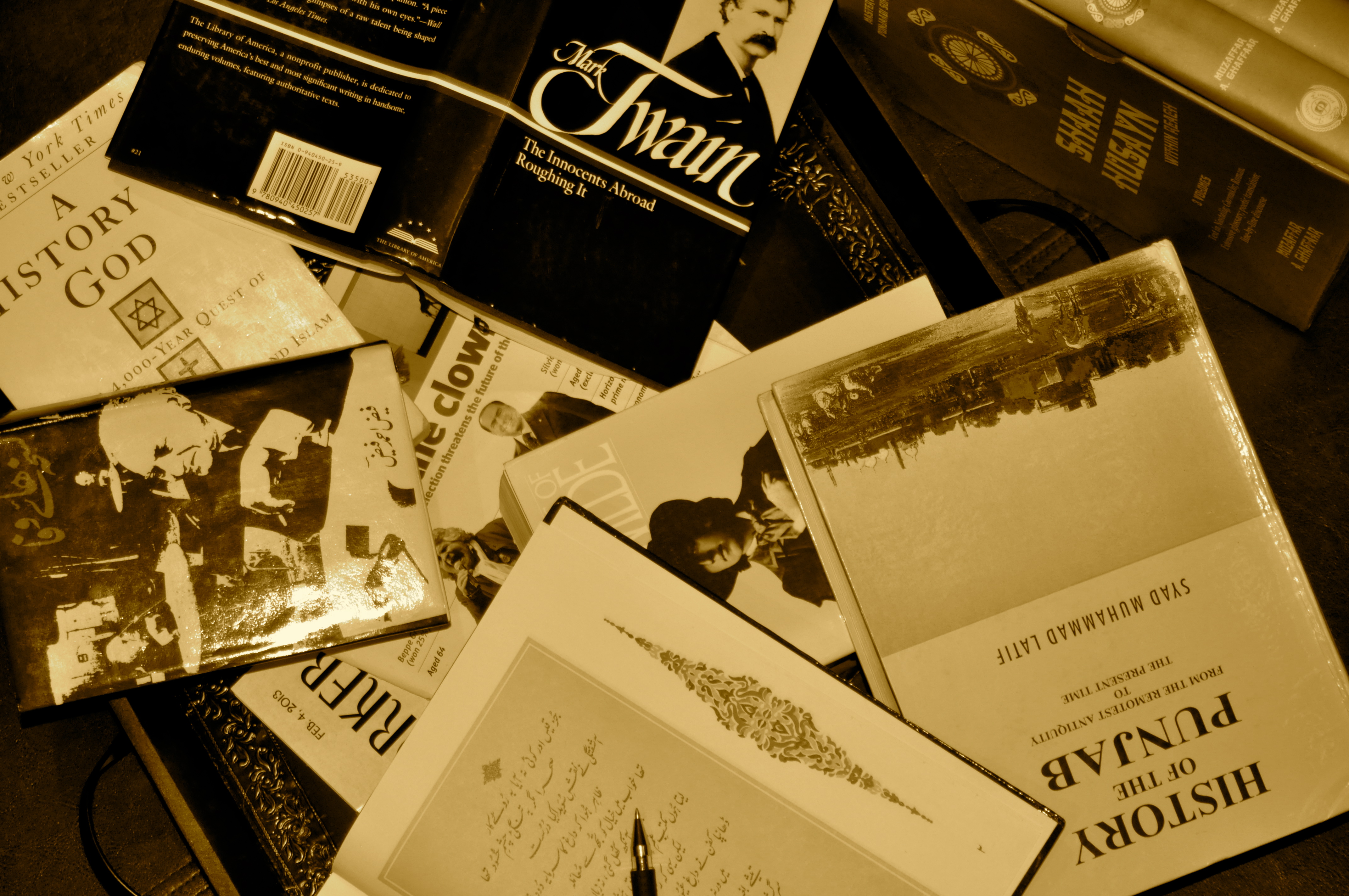
The Sage of Hannibal, Mark Twain, said: “My life has been full of misfortunes, most of which never happened.” Here Mark Twain shows us how hard it is to surrender; the mind is very creative in inventing a world of troubles in order to evade what is there in front of us, requiring attention. This imagined troubled world keeps at bay the responsibility of dealing with our immediate, present reality and what needs to be done, right here and now, in our neighborhood, in our families, among our friends and acquaintances. Mullah Nasruddin shows what Mark Twain is talking about in the episode where he is looking for the lost key. He goes looking not where it was lost but elsewhere where there is light. He wishes to appear to be doing the reasonable thing, although what he does is the convenient thing to do. It is like worrying about those visibly  hungry people or abused animals or nature in far away lands, rather than worrying about the people among our kin or neighbors who go hungry or can’t afford their medicines or are homeless, or taking care of the animals or nature in our vicinity crying out for a reprieve from man’s rapaciousness.  This is not meant to denigrate compassion for denizens of distant lands but people, indeed, are likely to look away from pressing realities that need to be faced in their immediate lives.

In the great silent movie Metropolis, directed by Fritz Lang in 1927, was this quote, “The mediator between the brain and the hands must be the heart.” The brain seems to be the material substrate of the mind. And what is this intangible quality called the heart? Is its material substrate the physical heart? Is it intuition? Is it compassion? Whatever it is, it is clear that if it is negated, as shown in the movie, we are left with the undead, the zombies, the robots. The heart does indeed redeem the brain and the hands.

In “A Case for Irony” by Jonathan Lear, Kierkegaard is reported to have asked, “In all of Christendom, is there a Christian?” This is an anguished cry of the heart, pining for perfection in the human heart, brain, and hands. Yet this pining for the perfect, as the Sage of Hannibal shows, can divert us from the path of reality and surrender, i.e., the way. The Greeks knew this well, this need to start from human reality, from what has been given to us, from what there is. This has much in common with Zen and Tao practice and teaching, not to mention the wisdom in  Sufi tales, such as those of Mullah Nasruddin.

In a review of the aforementioned book in The Psychoanalytic Review (volume 4, 2012), Alfred Margulies quotes Pindar, the ancient Greek poet: “Become such as you are, having learned what that is.”

A monk says to the Zen teacher: “I have been at this temple for quite some time now and I have not received any individual teaching from you.”  The teacher replies: “Whatever could you possibly mean by that. Haven’t you been greeting me every morning and  haven’t I been answering you?  You have been serving me tea and I have been enjoying it. What more could you possibly be looking for?”

The gist of all of the above is given in a Tao aphorism: “The Path is near, yet people look for it afar.” It is stated in even simpler words by Ibn Abbad (as quoted in “Merton and Sufism” by Rob Baker and Gray Henry): “The Way is plain.”

Essay by Modaser Shah; photo by Ali Hammad

Posted in Classic Teaching, Modaser Shah, Original Essays, Original Photography | Tagged , , , , | 10 Comments

Hagar’s Skirt

A REFLECTION BY DR ALI SHARIATI (1933-1977)

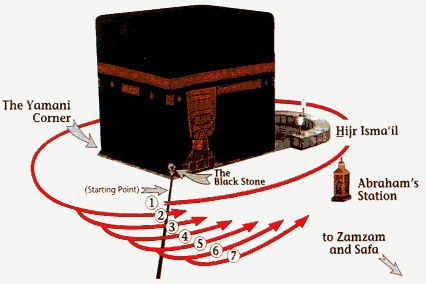
When you are at the threshold of Masjid al Haraam in Mecca, the Kaabah is before you. An enormous courtyard and in the center, a hollow cube.

Here, there is nothing. Nothing to even see. An empty room, that is all. There is nothing here. There is no one here.

Why a cube?

The cube faces all, faces none, everywhere, all directions and yet, no direction.

But wonder! To the west of the Kaabah is an addition, changing its shape and giving a direction to it. What is this? A short, arched wall facing the Kaabah. It is named the Hijr of Ishmael!

Hijr means skirt! And it actually resembles a skirt. The skirt of a dress, the dress of a woman.

Yes, Hagar.

An Ethiopian woman. A slave! A black slave. The slave of another woman, Sarah, wife of Abraham. A slave, so humble, that the other woman chose her as her husband’s mistress. That is, she was so abased that she would never be considered as being a rival wife.

A woman who, in human systems, lacked every dignity, every honor, and then God united the mystery of her skirt with the mystery of His existence.

This is the skirt of Hagar’s dress. The skirt which nourished Ishmael. Here is Hagar’s home.

Hagar is buried near the third pillar of the Kaabah. Amazing! No one, not even a Prophet should be buried in the mosque. And here, the House of God, wall to wall with the house of a female slave.

And the House of God, the burial place of a mother. God’s non-direction is only directed from her skirt. The Kaabah has extended towards her!

Circling around the Kaabah, the mystery of monotheism, without circling around her skirt is not accepted.

All of humanity, all who have accepted God’s invitation, should circle around the skirt of her dress as well. Her house, her grave, her skirt, also, are part of the tawaaf (circumabulation), are a part annexed to the Kaabah.

For the Kaabah, this absolute, non-direction is only directed towards this skirt. The Kaabah is directed towards the skirt of an African slave, a good mother.

The God of monotheism, seated upon His Omnipotent Throne, He is Alone. But it seems as if from among all His creatures, in His infinite Creation, He selected one.

Among all?  A woman.

A black woman.

A black slave woman.

A black female slave of a woman.

The most humiliated of His creatures.

He has placed her beside Himself, a place beside His House. Becomes her neighbor.

And now, under the roof of this House, two:

One, God.

And the other, Hagar.

Image

Article excerpted from “Hajj: Reflection on Its Rituals” by Ali Shariati, translated by Laleh Bakhtiar

Contributed by Navid Zaidi

Posted in Classic Teaching, Navid Zaidi | Tagged , , , , , | 4 Comments

Pain, Sin, and Fear

by Navid Zaidi

We often wonder about certain propositions concerning the nature of humans and the world. For example, one psychological implication may be the central fact of pain as a dominating element in our lives. Human beings, regarded as an individuality, are helpless against the forces of pain. Our individual consciousness constantly faces the possibility of pain. Freedom from pain may mean freedom from individuality. So, starting from the fact of pain, this proposition may place before us the ideal of self-annihilation. If pain is the ultimate fact, sense of personality may be a delusion. According to this proposition, then, we may emancipate ourselves from pain by stopping those activities which intensify our sense of personality. Salvation, then, may lie in inaction, renunciation of self and unworldliness.

Similarly, another proposition may be based on sin. The world is regarded as evil and the taint of sin is regarded as hereditary to humanity who, as an individuality, is incapable of dealing with it.

Again, yet another proposition looks upon nature as a scene of struggle between good and evil, and recognizes that humanity has the capability to choose any course of action she likes.

Now, is there an answer to the above views of the world and humanity? Is there a central ideal which determines the structure of the entire system?

The world is a reality and consequently we recognize as reality all that is in it. Evil is not essential to the world; the world can be reformed; the elements of evil can be gradually eliminated. The seemingly destructive forces of nature can become sources of life if properly studied by humanity who is endowed with the power to understand and to utilize them for her own good.

This view is neither optimistic nor pessimistic; it is melioristic—the belief that the world can be made better and that its betterment can be aided by human effort.

Although we recognize the facts of pain, evil and struggle in nature, yet the principal fact that stands in the way of humanity’s progress is neither pain, nor sin, nor struggle. It is fear to which humanity is a victim due to its ignorance of the nature of its environment. The highest stage of humanity’s progress is reached when it becomes absolutely free from fear.

This view of the world also indicates the spiritual nature of humankind. Says Dr Allama Iqbal:

Man must be regarded as a unit of force, an energy, a will, a germ of infinite power, the gradual unfoldment of which must be the object of all human activity. The essential nature of man, then, consists in will, not intellect  or understanding.

Humanity is essentially good and peaceful, a view explained and defended by Rousseau, the great father of modern political thought. The opposite view, the doctrine of wickedness of humanity, leads to the worst religious and political consequences. Since, if humanity is elementally wicked and evil, it must not be permitted to have its own way, its entire life must be controlled by external authority. This means priesthood in religion and autocracy in politics.

The ethical ideal of humanity is to free itself from fear, and thus to give itself a sense of its personality, to make it conscious of itself as a source of power. This idea of humankind as an individuality of infinite power determines the worth of all human action. That which intensifies the sense of individuality in humans is good, that which weakens it is bad. Says Dr Allama Iqbal:

Man is a free responsible being; he is the maker of his own destiny; his salvation is his own business.

Posted in Classic Teaching, Navid Zaidi, Original Essays | Tagged , , , , | 3 Comments

Sufi Snaps: Sea (A photo)

by Ali Hammad

IMG_0884 - Version 4


Photo by Ali Hammad

Written in response to WordPress Weekly Photo Challenge:Sea

Posted in Ali Hammad, Original Photography | Tagged , , , , , , , , , | 6 Comments