Guru Arjan Dev and Mian Mir: A Tale of Love and Friendship between two Sufi masters

Mian Mir and Arjun Dev

by Navid Zaidi

Guru Arjan Dev (1563-1606) was the fifth Guru of the Sikh faith that flourished in the Punjab region of India from the sixteenth century onwards.

Hazrat Mian Mir (1550-1635) was a famous Muslim Sufi saint who resided in and around the city of Lahore in the Punjab. Both men became life-long friends and devotees and their love and friendship glorifies the Sufi doctrine of love for all.

The period of the fifth Guru Arjan Dev is important for many reasons. First, it was Guru Arjan who arranged for the Garanth Saheb to be recorded and it became a Sikh holy scripture of great symbolic power. Secondly, Mughal hostility and persecution became evident during his time.

The Mughals, particularly Emperors Jahangir and Aurangzeb, persecuted the non-believers for political and religious reasons. In fact, not only Hindus and Sikhs but also Shia Muslims and Sufi saints became their victims.

The Sikh faith boldly declared equality and justice for all at a time when the Punjab was engulfed by extreme religious and social hatred, intolerance and inequality among various faiths, castes and creeds. Said Guru Gobind Singh:

Recognize all mankind, whether Hindus or Muslims, as one,

              The same Lord is the Creator and Nourisher of all,

              Recognize no distinction among them,

              The temple and the mosque, the Hindu and Muslim prayer,

              Men are all one.

This message of tolerance and religious co-existence was well received by the masses especially the Muslim Sufi saints of the Punjab.

Guru Arjan Dev often visited Lahore, the birthplace of his father, the fourth Guru Ram Das. On the occasion of one such visit he called on Hazrat Mian Mir and the two Sufi masters met and became life-long friends. Mian Mir was 13 years older than Guru Arjan.

Mian Mir was highly respected by the Sikhs. He was a man who had a deep love for Guru Nanak’s teachings. Mian Mir often traveled to Amritsar to meet with Guru Arjan. In turn, whenever Guru Arjan visited Lahore he would always meet with Mian Mir. Main Mir knew a large number of Guru Arjan’s verses by heart.

In 1588, Guru Arjan Dev planned to build a temple in Amritsar, now known as the Golden Temple. The temple was to be open to people of all castes and creeds. The Hindu temples were closed on three sides and their entrances were generally towards the East while Muslim mosques had entrances towards the West. The Sikh temples had entrances on all four sides denoting that God was in all directions and that the Gurudwara was open to all.

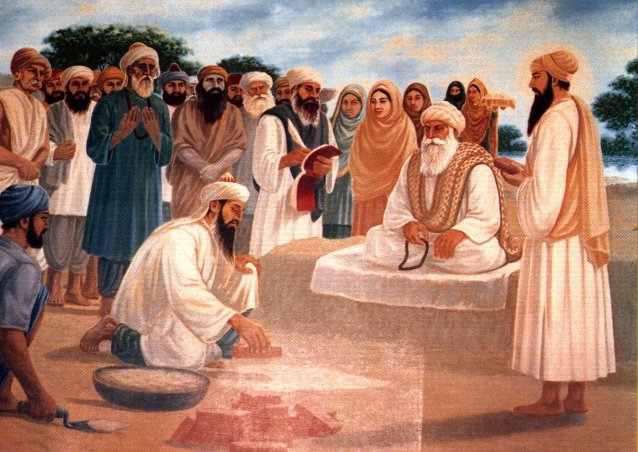
Guru Arjan invited Mian Mir to lay the foundation stone of the Golden Temple. Mian Mir was given a customary warm welcome. The two masters embraced each other in sincere love and regard. Mian Mir was delighted with Guru Arjan’s ideas, the foundation stone was laid, hymns were sung in the praise of God and sweets were distributed.

The Mughals were getting uneasy with Guru Arjan’s popularity with the masses. In 1606, Guru Arjan Dev was charged by Emperor Jahangir with heresy and support of Prince Khusrow, his son, in the struggle for the throne. Emperor Akbar was unhappy with Jahangir and had designated his grandson Khusrow as his preferred choice for the Mughal throne.

Guru Arjan was imprisoned in Lahore Fort and tortured. When Mian Mir heard about it, he went to see Guru Arjan. Mian Mir was deeply saddened to see his friend in such misery, but he found Guru Arjan calm and serene, having completely resigned himself to the will of God.

Mian Mir suggested to the Guru that he should intercede with Emperor Jahangir on his behalf. The Guru forbade him. Then Mian Mir sought the Guru’s approval to raze the city of Delhi down to the ground with his spiritual powers. Guru Arjan replied:

‘ I can also do that but under all conditions one must live in the will of God.’

Guru Arjan Dev was tortured to death in 1606 and became the first martyr of the Sikh faith. Mian Mir raised slogans to mourn the martyrdom of Guru Arjan. He never accepted any gifts sent by Emperors Jahangir and Shah Jahan or their ministers and nobles.

A couple of years after the martyrdom of Guru Arjan, his son and successor Guru Har Gobind, then a boy of 13, called on Mian Mir at Lahore. Guru Tegh Bahadur, the ninth Guru, also met Mian Mir as a child who blessed him.

Posted in Navid Zaidi | Tagged , , , | 1 Comment

The Second Half

By Tabassum Saba

“Is this all there is?” Many people of my age are asking this.

Why this has become a nagging question for many of us? I think it’s because we were prepared to fulfill the goals of first half of our lives and now that those responsibilities are somewhat out of our way and we are still alive (thanks to medical science that is prolonging our lives) and wondering what to do next .We were not prepared for the second half of our lives. In order to get ourselves ready for that we will first have to let go of the first half and the things and goals which were important have served their purpose and may not help at this stage of life.

We have to come with new ideas, tools and goals for the second half. We seldom had the clear concept during our childhood of who we would be on becoming an adult. However, as we grew older things were unfolded for us one by one. If we allow that the same will happen for the later years, we first have to examine the earlier years. We can look back and rejoice or can go in despair when we examine our youth in our middle years.

If we can rejoice our youth then it’s great, but getting stuck in glory of the past can make us stagnant. If we feel despair then the acceptance of and coming to the conclusion “it is what it is” can help us step in the second phase of life, because the second phase is not less important than the first one and we have to participate in this with as much vigor and enthusiasm as we did with the first half of life.

We have to let go of our role of being a follower and assume the role of a wise elder and leader. A leader is a person who has a better control of his or her emotions, is wiser, and mature. The true leaders know that they can teach only by setting an example and in a way life is giving us another chance to straighten up our acts before it’s too late. The wise elders are those who can understand the dilemmas of others especially of the youth  and should know when to guide and when to step back. The exceptions to this rule are those chosen ones like prophets who have to convey the message whether the ground for it is prepared or not.

Ashfaq Ahmed in his masterpiece play “Man Chuley Ka Soda” describes a state when a student is scolded by his Sufi master about being stuck in the role of seeker and wants to stay in that role forever. The master informs him that he can’t be a student all his life he has to step up and assume the role of the teacher. The seeker is afraid of taking this step because, in a way, it’s much harder than the first half because it brings more responsibility and personal accountability. Yet it’s now his responsibility to pass on the wisdom which he has learned over the course of years, no matter how incomplete this wisdom sounds. Ashfaq Ahmed himself assumed the straightforward role of a teacher at the end through his last work “Zavia”. Mumtaz Mufti, a malamti Sufi, could not find the courage to teach like Ashfaq Ahmed and would not even take any credit for his writings, saying that SOMEONE else was writing behind him, but at least he let it flow through him and did his duty faithfully till the end.

The fear of becoming a leader in our personal, professional and spiritual lives (all of which are inter-related) can be paralyzing. Sarfraz Shah gives hope that the teacher in the process of training his or her students evolves with them. Anyone in the teaching profession will agree with this. Actually there are always students who would graduate from the level of their teacher to the next level and it happens all the time. “Mun Chuley Ka Soda” ends on that note.

The fear of assuming the role of a leader is a common phenomenon especially among women. Teresa of Avila (1515- 1582) was allowed to be a nun, but  as a woman she was not allowed to study theology and was required to take constant guidance from the theologians, all of them were men, many of them much younger than her. They would often tell her that her spiritual experiences and ideas were work of the devil and she believed them until she was in her late 40’s and had an epiphany that she was fully capable of understanding what was happening to her. The turning around of a woman around this age and finding a new confidence in herself is not uncommon and Dr. Northrup has explained its biological basis in her book “Women’s Bodies, Women’s Wisdom”. When Teresa of Avila found that inner strength a human validation also came (as it often happens)  from Peter of Alcantara whom she met in 1560 in Toledo, Spain.

She let her fears go and wrote “Not a fig do I care for all the devils in hell. Its they who will fear me! Oh, the devil!! The devil we say, when instead we would say, God! God and make the devil tremble. I am sure I fear those who are terrified of the devil more than I fear the devil himself.”

Having confronted her fears, a different woman emerged. We now know her as Saint Teresa of Avila. The one who was a now a leader of her spiritual order for her remaining years, which were the most productive years of her life.


References:

(1) Mun Chuley ka Soda (in Urdu) by Ashfaq Ahmed

(2) Fakir Rung (in Urdu) by Sarfraz Shah

(3) Dark Night of The Soul by St. John of the Cross, Explanation by  Gerald G. May, MD

(4) Sacred Contracts by Caroline Myss

(5) Falling Upwards by Richard Rohr

(6) My Years with the Qutb by Sharon Marcus

(7) Women’s Bodies, Women’s Wisdom by Christiane Northrup

Posted in Tabussum Saba | Leave a comment

The Emergence of Religions of Earthly Salvation

by Navid Zaidi

Nowadays,  humanity finds itself dramatically at odds with ancient religious doctrines which are steadily losing credibility.

Among the youth in particular, matters are falling apart- manners and knowledge, the sense of history, interest in politics, acquaintance with art, religion and literature- mankind finds itself alone for the first time, deprived of the support of both the cosmos and God.

Over the past two centuries, the Moderns have invented, what we might call, in the words of Prof Luc Ferry of the University of Paris, the ‘religions of earthly salvation’  notably scientism, patriotism, nationalism, atheistic socialism, capitalism and communism.

Unable to continue believing in God, the Moderns have produced substitute-religions and godless spiritualities. While professing a radical atheism, these ideologies try to give meaning to human existence and even justify why one should die for them.

All of these grand human utopias call to sacrifice life for a nobler cause; whether that means the Revolution, the Homeland or the Truths of Science. Nietzsche called them the three ‘idols’.

We have seen in history that the Communist ideal was so powerful, so ‘sacred’ and justified laying down one’s life without fear or remorse.

Even today, there are national anthems that exhort the citizens to sacrifice their destiny as individuals to the ‘higher cause’; to die for the homeland is to enter into eternity. We can find in this spectrum forms of patriotism and nationalism- the notion that it is worthwhile to give one’s life for one’s nation.

Similarly, scientism gives its followers reasons for living and dying. Scientists, explorers and builders are convinced that by discovering new planets or a new scientific law, or by inventing new machines, they are inscribing their names in the eternity of human progress that justifies their entire existence.

I have to say that, frankly, these new religions such as nationalism, patriotism, communism, capitalism or scientism (or any -ism ) are desperately empty abstractions. Nationalism, communism and capitalism caused the deaths of multitudes but even if we devote ourselves to a ‘higher cause’ it remains true that in the end it is the individual who suffers and dies.

As Nietzsche asked: ‘Is not the passion for ‘grand designs’ that are supposedly superior to the mere individual, merely the final ruse of those religions that we hoped we had left behind’.

The Moderns are seeking fresh sources of energy in the creation of new loyalties, such as nationalism, capitalism and patriotism. No wonder Nietzsche described them as ‘sickness and un-reason’ and ‘the strongest force against culture’.

Posted in Navid Zaidi, Uncategorized | 1 Comment

How Faith Replaced Kosmos: The Revolt Against Greek Thought

by Navid Zaidi

The period 800-200 BC has been called the Axial Age. For reasons that are not entirely understood, all the chief civilizations of the world developed during this period along parallel lines ; Taosim and Confucianism in China, Hinduism and Buddhism in India and philosophical rationalism in Europe. In the Middle East, Zoroaster and the Hebrew Prophets, notably Elijah, Isaiah, Amos and Hosea, evolved different versions of Monotheism.

Philosophical rationalism arose in Greece some time around the sixth century BC. So sudden and so astonishing was its rise that it has become known as ‘the Greek miracle’. Among the Greek elite, unprecedented freedom and autonomy of thought were favored, and in their assemblies, the citizens acquired the habit of public debate and argument. Zeno (334-262 BC), the founding father of the Stoic school, gave free and open lessons to all comers.

In the Greek tradition, the innermost essence of the world is harmony, order—both true and beautiful—which the Greeks referred to by the term kosmos.  For the Greeks, the structure of the world—the cosmic order—was not merely magnificent, it was also comparable to a living being. Wrote Marcus Cicero in the first century BC, “…….It remains no less true that nothing is more perfect than this world, which is an animate being, endowed with awareness, intelligence and reason.”

If anyone claimed today that the world is alive, animate—that it possesses a soul and is endowed with reason—he would be considered crazy. But what the Greeks were trying to say was by no means absurd: they were convinced that a ‘logical’ order was at work behind the apparent chaos and that human reason was able to discern the divine character of the universe. They thought that this order, or kosmos, this ordained structure of the universe in its entirety, was ‘Divine’, ‘Well-made’ and perfect of itself, from the planets down to the tiniest organisms.

The Greek wisdom still speaks to us today, through the centuries and overarching many cultures. However, we no longer inhabit the world of Greek antiquity and their great cosmologies have for the most part vanished. Greek wisdom was not enough to stop the emergence of competing systems of thought and, specifically, to prevent the spread of Monotheism. Monotheism, mainly Christianity and Islam, was to deal the Greeks a lethal blow, pushing it to a marginal position for nearly 1500 years.

How did that happen?

The Greek world was fundamentally aristocratic, an elitist world, a universe organized as a hierarchy in which those most endowed by nature should in principle be ‘at the top’ while the less endowed saw themselves occupying inferior ranks. In the moral vocabulary of the ancient Greeks, the notion of ‘virtue’ was always directly linked to those of talent or natural endowment. Aristotle speaks of a ‘virtuous eye’ in one of his works devoted to ethics, by which he simply means an ‘excellent’ eye, a perfectly functioning eye, neither long-sighted nor short-sighted.

The Greek world rested entirely upon the conviction that there exists a natural hierarchy, of organs, of sight, of plants or of animals, but also of men: some men are born to command, others to obey.

The Greek doctrine of salvation was utterly anonymous and impersonal. It promised eternity, of course, but of a non-personal kind, as an oblivious fragment of the kosmos: death, for the Greeks, was a mere rite of passage, which involved a transition from a state of individual consciousness to a state of oneness with the kosmos.

THE MOVEMENT OF JESUS AGAINST THE GREEKS

Such was the state of thought in the Roman Empire when Jesus Christ appeared. Following the formula of theory, ethics, and wisdom, Jesus radically ruptured the Greek world and outlined a new morality and a doctrine of salvation based on faith and love. Thus did religion capture the hearts of humanity and gained the upper hand over Greek thought and dominated Europe. This was no small achievement.

What were the reasons?

Firstly, and most fundamentally, the Logos, which for the Greeks merged with the impersonal, harmonious and divine structure of the Kosmos as a whole, came to be identified for the Christians with a single and unique personality, that of Christ. To the horror of the Greeks, the new believers maintained that the Logos was in no sense identical with the harmonious order of the world, but was incarnated in one outstanding individual, namely Christ. This left the Greeks stone cold.

Secondly, the way of seeing, contemplating, understanding and approaching Reality was transformed. From now on, it is no longer reason that will be the theoretical faculty of excellence, but faith. And so, faith began to supplant reason. Truth is no longer accessed through the exercise of a human reason. What will count, above all, is no longer intelligence but trust in the word of a man, Christ. We are going to believe him because he is worthy of this act of faith.

Thirdly, what was required to put into practice this new system of thought was not the comprehension of the philosophers, but the humility of the simple folk. The belief in a natural hierarchy has no legitimacy. To speak of a ‘virtuous eye’ no longer makes any sense, because the gifts received at birth are unequally distributed among men, some men are much stronger or more intelligent than others, just as there exist in nature sharper eyes and less sharp eyes. These inequalities have no bearing on morals. All that counts is how we use the qualities, not the qualities themselves. What counts as moral or immoral is the act of choice, what philosophers began to call ‘free will’. Human dignity is the same for everyone, whatever their actual inequalities, because it is connected to our freedom to choose how to act, not upon our innate endowments. This was unheard-of at the time, and it turned an entire world order upside down.

Fourthly, philosophy becomes the ‘handmaiden’ to religion. Reason would be entirely subjected to the faith which guides it.

THE ANTI-CLASSICAL APPROACH OF THE QURAN

Greek philosophy was a great cultural force in the history of Islam. But while Greek philosophy very much broadened the outlook of Muslim thinkers, it was pure speculation, theory, and neglectful of fact. The spirit of the Quran was essentially anti-Greek. The appeal to the concrete combined with the slow realization that, according to the Quran, the universe is dynamic in its origin and capable of increase, eventually brought Muslim thinkers into conflict with Greek thought.

Plato was convinced that the divine world was static and changeless. The Greeks saw movement and change as signs of inferior reality; something that had true identity remained always the same, permanent and immutable. The Quranic view of ‘alternation of day and night’ as a symbol of the ultimate reality which ‘appears in a fresh glory every moment’ is in total conflict with Greek thought of a static and changeless universe.

All lines of Muslim thought converge on a dynamic conception of the universe, the essentially Islamic idea of continuous creation which means a growing universe. This concept required a keen sense of the reality of time, and the concept of life as a continuous movement in time. For the Greeks, time was either unreal, as in Zeno and Plato, or moved in a circle, as in Heraclitus and the Stoics.

Socrates concentrated his attention on the human world alone. To him, the proper study of man was man and not the world of plants, insects and stars whereas the Quran sees in the humble bee a recipient of divine inspiration.

As a true disciple of Socrates, Plato despised sense-perception, which in his view yielded mere opinion and no real knowledge. How unlike the Quran, which regards ‘hearing’ and ‘sight’ as the most valuable divine gifts.

This prolonged intellectual warfare of Muslim thinkers against Greek philosophy consisted of formulation of the principle of ‘doubt’ as the beginning of all knowledge, a systematic refutation of Greek Logic, criticism of Aristotle and showing that induction is the only form of reliable argument. Thus arose the method of observation and experiment.

But it was the conception of a continuous life and time which is the main point of interest in Ibne Khaldun’s view of history, and the way in which he conceives the process of change. He implied that history, as a continuous movement in time, is a genuinely creative movement and not a movement whose path is already determined. In the work of his genius the anti-classical spirit of the Quran scored its final victory over Greek thought.


REFERENCES:

Karen Armstrong:  A History of God

Luc Ferry:  A Brief History of Thought

Sir Muhammad Iqbal:  The Reconstruction of Religious Thought in Islam

Posted in Navid Zaidi | Tagged , | Leave a comment

From Simplicity through Contradiction to Paradox

by Modaser Shah

The title is from a paper by the prodigious and acclaimed Indian analyst Salman Akhtar writing in a psychoanalytic journal. I imagine him to be a hidden Sufi or at least steeped in Sufi wisdom and literature. His three-step process in evolution of psychic reality includes: 1) Simplicity: experiencing disparate psychic states without awareness of their inherent contradictions, 2) Contradiction: acknowledging and mending the factors responsible for logical incompatibilities, and 3) Paradox: developing a capacity for feeling and accepting the coincidence of multiple feelings at different levels of abstraction.

Thus, Akhtar’s paradox is an acceptance, i.e., an effort to avoid forcing reality into a conceptual cage. And with that one comes back full circle to a kind of simplicity—a simplicity into which complexity and contradiction are now woven seamlessly.

The above, too, is the teaching of the Sufis, as is manifest in many of the anecdotes of Mullah Nasruddin that we have alluded to in previous articles, and that is also seen in the trope of some Sufi-inspired hakayaat (old tales) of Persian and Urdu literature in which a prototypic, nameless fakir (an ascetic sage) when faced with or asked about a rather ordinary situation alternately weeps and laughs, indicating his realization of contradictions hidden within the matter, contradictions that were not readily evident to us. The hope is that the reader will pass to the stage of what Akhtar calls paradox, where there is acceptance of coincidence of multiple feelings and multiple solutions.

Let us then alternately cry and laugh.

Start with simplicity. Add a pinch of Nasruddin and see contradictions crop up all over the place. Compare the child’s world with that of a grown up, or Aristotle’s logic with the dialectical logic of Hegel, or Newtonian physics with quantum physics, or modern with postmodern thought, or Sufism with Sharia, or behaviorist psychology with the psychology of complex mental states. Contradiction and confusion are hard to live with, but they may be entirely arbitrary. For example the separation between a child and a grown-up may be artificial.

What we learn from Nasruddin is that the essential is not always to be found in what is considered the norm or the convention, be it conventional language, conventional morality, conventional ideology, conventional economy, conventional political system, conventional liberalism, or conventional conservatism. And we can go on, but recalling the story of Mullah’s walk, it may be best to stop.

Life with the Mullah as a guide shows us that the essential contains the inessential and the trivial. The trivial hides within it the essential. Capitalism has socialism in it and vice versa; religion, irreligion; atheism, theism. As a spokesperson of the Sufis, Nasruddin in some of his anecdotes hints that a question may itself be the answer, a position similar to Zen that tells us that all questioning is a way of avoiding the real answer, which is really known already.

Getting back to Akhtar’s cycle of simplicity, contradiction, and paradox leading back to a complex simplicity, we see that it requires effort, an expenditure of energy. The first law of thermodynamics as stated by Michio Kaku is validated: you can’t get something for nothing. But the higher simplicity obtained after going through contradiction and paradox releases more energy than it consumes. This defies the second law of thermodynamics a la Michio Kaku: you can’t even break even. So, here you travel from the realm of physics to that of metaphysics, a new existence opens up.

And, for the sake of completion, the third law of thermodynamics, as stated by Kaku is: you can’t get out of the game. That, indeed, may be ever true.

Posted in Authors, Modaser Shah, Original Essays | Tagged , , , , , | Leave a comment

The Freedom of the Self

by Navid Zaidi

“You sound to me as though you don’t believe in free will,” said Billy Pilgrim.

“If I hadn’t spent so much time studying Earthlings,” said the Tralfamadorian, “I wouldn’t have any idea what was meant by free will. I’ve visited thirty-one inhabited planets in the universe, and I have studied reports on one hundred more. Only on Earth is there any talk of free will.” ——Kurt Vonnegut, Slaughterhouse Five, 1969

Is the human Self free?

Do we have free will?

Explains Sir Muhammad Iqbal in his lecture ‘The Human Ego- His Freedom and Immortality’ that the human Self is not something rigid. It organizes itself in time and is formed and disciplined by its own experience. Data streams into it from Nature and from it to Nature. So the question arises, does the Self determine its own activity?

The ‘mechanistic’ view of human action is understood to be a conflict of motives fighting each other on the arena of the mind caught in a web of cause and effect. Yet the final choice is determined by the strongest force. This gives us a mechanistic interpretation of consciousness.

However, this controversy between Mechanism and Freedom arises from a wrong view of intelligent action. A careful study of intelligent behavior discloses that the human Self possesses an ‘insight’ over and above the mere sensations. This ‘insight’ is the Self’s appreciation of the causal relation of things, the choice of data in a complex whole, in view of the goal or purpose which the Self has set before itself for the time being.

It is this sense of making the effort and having an experience of purposive action that convinces us of our personal freedom. It does not matter whether we achieve success in reaching our ‘ends’ but the simple fact that we can vision a future situation means we have free will. Our thoughts of changing ‘what is’ into ‘what ought to be’ appear to have no physiologic explanation in terms of cause and effect.

The chain of cause and effect is an artificial construction of the human Self for its own purpose. The body, the organs, the cells, the molecules and the chemicals are all instruments of the Self. The Self is a priori but it is called upon to live in a complex environment and cannot maintain its life without reducing it to a system of cause and effect which would give it some kind of assurance as to the behavior of things around it.

Therefore, the mechanistic systems of our body and organs are simply an indispensable instrument of the Self, not the final reality. Indeed, the Self understands and masters the current environment through the use of cause and effect systems in order to acquire and amplify its freedom.

The element of insight, guidance and directive control in the Self’s activity shows that the human Self is free.


References:

Sir Muhammad Iqbal:  The Reconstruction of Religious Thought in Islam
Owen Flanagan:  The Problem of the Soul

Paul Davies:  God and the New Physics

Posted in Navid Zaidi, Original Essays | Tagged , , | Leave a comment

The (Deeper) Movement of Thought

by Navid Zaidi

There is a very simple, almost unspoken law, the law being that if any two things interact, they must be in some way like each other.

It is quite possible for somebody who looks at the Sun at sunrise on a nice morning, to have a beautiful, poetic thought about it. We can look at the chain of events, which goes to produce that poetic thought. It starts off in the Sun as an atomic reaction, with light being emitted, traveling across space and upper atmosphere, reaching the eye, and traveling as a nerve impulse to the brain, and then producing a thought.

Now, there are two ways of looking at this. Either we can say that thought is a form of energy, or energy is a form of thought in some way. It may be equally valid to say that the energy that is in the universe is in some way related to thought. In other words, Universe = Thought.

How is this possible? Commonly, Thought is considered as an agency that works on things from the outside; we think about things which appear to us as a confronting ‘other’.

However, it is possible to take Thought as a potency that forms the very being of material things. Thought is the ultimate ground and constitutes the very essence of matter. It infuses itself into matter from the very beginning and inspires its onward march towards a self-determined end.

In its essential nature and deeper movement, Thought is not static. It is dynamic and unfolds itself in time just like the seed which, from the very beginning, carries the tree within itself as a present fact.

But our present situation and alliance with serial time and space necessitates the dualism of Thought and Being. We bifurcate ourselves and the confronting ‘other’ as subject and object. But in reality, all is One; there is no ‘other’ and every act of human knowledge is a Unity. Thought and Being are ultimately One.

Since we cannot conceive of Thought independent of a mind, for there to be one universe that everyone observes as being the same, there must be one mind producing the thought!

In his award-acceptance speech, the Nobel prize winner and father of the Quantum Theory, Max Planck said:

As a man who has devoted his whole life to the most clear-headed science, to the study of matter, I can tell you as the result of my research about atoms this much: There is no matter as such! All matter originates and exists only by virtue of a force which brings the particles of an atom to vibration and holds this most minute solar system of the atom together…….We must assume behind this force the existence of a conscious and intelligent mind. This mind is the matrix of all matter.

The great Sufi masters urge us to match up with this Mind.


References:

Sir James Jeans:  The Mysterious Universe

Carl Sagan:  The Varieties of Scientific Experience

Dr Wayne Dyer:  The Power of Intention

Sir Muhammad Iqbal:  The Reconstruction of Religious Thought in Islam

Posted in Authors, Navid Zaidi, Original Essays | Tagged , , | 3 Comments

Sanity Guides

Ludwig Wittgenstein's grave

Ludwig Wittgenstein’s grave (Photo credit: shaggy359)

by Modaser Shah

“Wer den Wegweiser findet, sucht nun nicht nach einer weiteren Instruktion, sondern geht,” said Wittgenstein.¹ My translation of this is as follows: When one finds a guide(post), one doesn’t look for further instruction, one just goes.

That is to say, once one has a guide, one just goes toward the destination—unless one were wary of getting there.  Without a guide or a plan, the destination may be elusive or deceptively simple. To quote Paul Simon:

“You know the nearer your destination
The more you’re slip slidin’ away”²

Take the case of Mullah Nasruddin. Once when his wife advised him to go on a walk, he walked away from home in a straight line without a destination or a plan.³ In other words, he busied himself in an activity, not in the attainment of a purpose or a destination. He busied himself in getting nowhere. Indeed, all of us sometimes and some of us all of the time are busy in some activity, without bothering about the purpose or the destination. In the story of his walk, the Mullah seems to fit this mold. Unless his point was that stated in the 18th century German writer Lessing’s dialectical saying, “He who on certain occasions does not lose his sanity shows that he has none to lose.”  So, Mullah Nasruddin, the comic hero of Sufism, by seeming to lose his sanity all too frequently, shows that he has lots of it. And perhaps in his purposelessness is an emphasis on purpose.

In contrast is the tragic hero of Sufism, Mansur Hallaj. He demonstrated an insanity of a different kind, an insanity that emanates from love. He was executed for shouting  repeatedly in public, “I am the Truth.” This expressed his inner state of union with God,  but did it have to be proclaimed loudly in public? Seemingly, it did. For one, we are still reflecting on its meaning hundreds of years later. Also, he had to proclaim it so that others  might  begin to think about destinations.

The Mullah and Mansur, the comic and the martyr, were carriers of important messages. Each was for us to witness and question and to realize that between comedy and tragedy lies fertile confusion. And that in this seeming confusion is where you find your identity and your sanity. This, perhaps, is the essence of these Sufis and in the persons of these two the message of Sufism intermingles the dialectical and the radical, the comic and the tragic…and more

References:

1) Zettel, quoted in Deutungs-Kunst, by Wolfgang Loch, edition diskord, 1993

2) From the song Slip Slidin’ Away by Paul Simon, 1977

3) Nasruddin’s Walk: How to fail better

Posted in Modaser Shah, Original Essays | Tagged , , , , , | Leave a comment

Confusion and Clarity and the In-between

by Modaser Shah

DSC_0323 - Version 2

Heinrich Racker, the well-known psychoanalyst from South America, notes in passing in a book that “clarity cannot be attained except through confusion,” a remarkable sentiment from a rather unexpected corner. Usually one expects this kind of insight from someone like Mullah Nasruddin, the Sufi character steeped both in wisdom and absurdity, in tragedy and comedy, in eminent sense and arrant nonsense, the high and the low and, one might add, the in-between. As critical it is to experience this in-between, it is hard. Most of us get stuck on one pole or the other, either  on the high or the low, either in wisdom or in absurdity, either in tragedy or in comedy, and so on.

Not so Nasruddin. He knows that the extremes coincide and join hands—indeed they must in the human heart. In between the lines of his counter-dogmatic stories is the message of the in-between. He may not talk about it but he constantly shows us the in-between, the path between opposites, the road between poles, the ladder between levels. Wittgenstein took a similar approach, so elegantly put in his Tractatus. He said that those who had understood his propositions would discard his book, just as someone who used a ladder to climb to a higher place doesn’t require the ladder any longer, implying that climber has understood that he hasn’t climbed anywhere; he remains where he started from, except that now he sees where he is.  The ladder is not needed. This is reminiscent of the saying attributed to Buddha: Dharma is to be used like a raft to get to the other shore. Thence, it needs to be discarded. Wittgenstein’s ladder or Buddha’s raft may be understood as one of the defense mechanisms of psychoanalysis, which were once crucial for survival but are still clung to tenaciously when  the threatening situations have receded into the background, and the need for a particular defense mechanism is  no longer there.

This brings to mind a story about Nasruddin. As he sat on a river bank, someone shouted to him from the opposite bank, “How do I get to the other side?” Nasruddin, ready as always, yelled back, “You are on the other side!” It is not known how the man took this answer and what he did with it. Did the answer help him? It is not possible to say. Did he feel helped? Probably not. But if he were ready to enter the in-between, then the Mullah would have become the teacher because, as goes the Sufi saying, when the student is ready, the teacher will be there. Points to ponder would have been: what if the other side is not the other side; what if there is no there; what if the there is here or, worse, neither here nor there?

Let us see if Proust can throw some light into this maze: “We do not receive wisdom. We must discover it for ourselves after a journey through the wilderness which no one else can make for us, which no one else can spare us.” (Zen Calendar, 2014, Workman Publishing, New York. Emphasis added.) And yet, according to Sufi and Zen tradition, at least for most of us, a guide or guidance is needed. Enter the Mullah, a confusing yet enlightening guide.

“Keep a green tree in your heart and perhaps the singing bird will come.” This is a Chinese proverb quoted in 2500 Years of Wisdom by D W Brown. I have added the emphasis because I feel convinced the Mullah would have relished stressing the perhaps, which points to an in-between area. So, like Nasruddin, relish the confusion and savor clarity.

DSC_0324 - Version 2

Essay by Modaser Shah; photos by Ali Hammad

Posted in Modaser Shah, Original Essays, Original Photography | Tagged , , , | Leave a comment

Sufi Lives: Rabia

by Ali Hammad

More than a millennium has passed since the times of Rabia, the patron saint of Sufism. The events of her life are now shrouded in an impenetrable veil of time. A few scraps of her biography are all we have, quite unreliable and done by people who came scores or hundreds of years later. The rest we have to imagine, like I did in the following account. Her message, however, has passed intact, her words guarded as sacraments never to be tempered with, by the countless succeeding generations of mystics. That, I think, is what she would have wanted. She was never about her. It was always about the Message.

DSC_0161 - Version 2

Ismail had run out of names for daughters by the time his fourth was born. He simply named her Rabia: Fourth. Each girl had added more financial stress. A son would have helped in keeping the family fed, but a son was not God’s will, and Ismail was not one to question God’s will. He didn’t complain or ask anyone for financial help. He thanked God for His bounty, loved his girls, and worked harder.

The year was 717 CE. Rabia was born at the edge of a desert, not far from the town of Basra in Iraq. The family was poor and remained so throughout her life. What Providence held back in money it did (temporarily) grant in love: Rabia had the love of her father, her mother, and her three older sisters. Then, in one turbulent year, everything blew away.

Ismail died when Rabia turned eleven. Her mother decided to move with her daughters to the town of Basra where she felt she’d be able to make a better living. The caravan with which the women were travelling was waylaid by highwaymen. The mother was murdered and each daughter enslaved by a different robber. Rabia’s family thus shredded, never to be put back together again.

Penniless, helpless, bereft of love, and entirely alone in a fearsome world, the eleven-year old girl was brought to Basra and sold promptly in its slave market. Henceforth she was known as Rabia of Basra, or Rabia Basri. And with her was to originate the doctrine of selfless love that in later years would be known as Sufism.

Continued on next page…

Posted in Ali Hammad, Original Essays | Tagged , , , , , , | 4 Comments